
Nutrition
Naturally good, naturally healthy
Milk
Milk, an essential nutritional ally at every stage of life.
Milk is a food we are introduced to in early childhood and that stays with us throughout our lives. It is a rich source of protein, minerals, and vitamins, which are essential for our bodies to function properly.
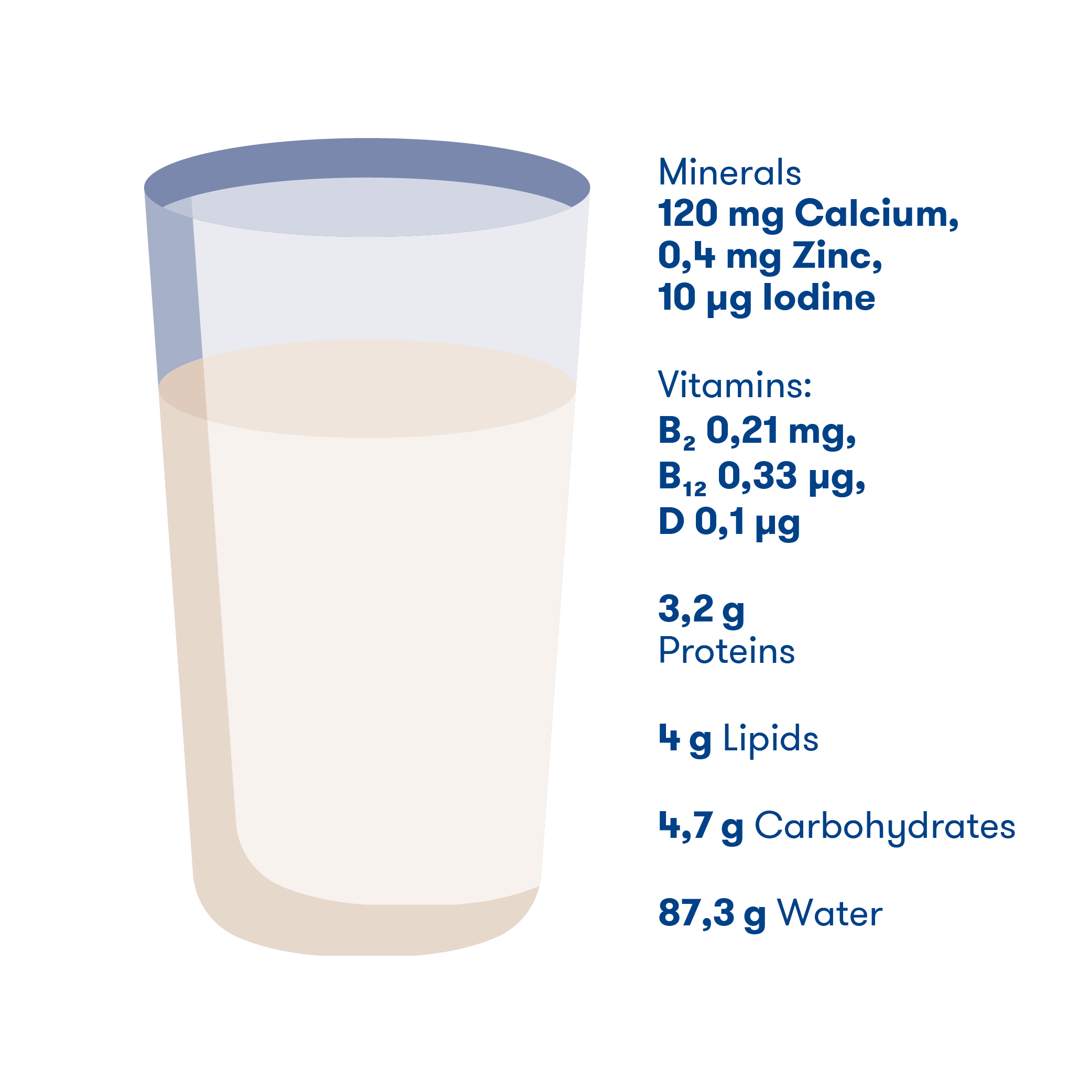
For 100ml of raw milk

Protein and fat
Proteins are essential for tissue formation—particularly muscle tissue—and for producing vital substances through amino acids. Fats, which are essential to the diet, protect organs, provide insulation, and serve as a source and store of energy, since the body does not produce them.

Vitamins
Vitamins, which are essential for the body to function properly, must be obtained through the diet. Milk, which is rich in minerals, helps the body metabolize fat-soluble vitamins (A, D, E, K) and water-soluble vitamins (B1, B2, B3, B5, B6, B12, C).

Minerals
The primary role of minerals is to support vitamin metabolism in the body and ensure that vitamins function properly. The body cannot produce any minerals on its own; they must be obtained through the diet.
100 g cow's milk
Contains the following vitamins
- The B-complex vitamins, which include vitamins B1, B2, B12, B3, B5, B6, and folic acid. One of the most important functions of this group is to help metabolize food; in other words, it helps the body obtain energy from carbohydrates, proteins, and fats.
- Vitamin C belongs to the group of water-soluble vitamins that help prevent circulatory diseases. Although milk does not contain much vitamin C, its antioxidant effect is significant.
- Fat-soluble vitamins A, D, E and K. Vitamin A is important for eyesight, healthy skin, mucous membranes and bones, and a strong immune system. Vitamin D enables the absorption of calcium and regulates its metabolism, as well as that of phosphate. Vitamin E is a powerful antioxidant, protecting the body from numerous toxic and carcinogenic substances. It also helps protect the heart and cardiovascular system. As for vitamin K, its role in blood coagulation and bone metabolism is well known and documented.
Contains the following minerals
- Calcium: bone and tooth formation, positive effect on muscles, nerves and blood coagulation
- Magnesium: regulates nerve functions and muscle contractions and promotes a balanced transition of calcium, sodium and potassium across the cell membranes of the digestive system.
- Phosphorus: contributes to the structure of bones and teeth and is also important for the proper functioning of the heart and kidneys, as well as for the transmission of nerve impulses.
- Potassium: transmits nerve impulses, affects muscle contraction, maintains normal blood pressure, and has a beneficial effect on embryonic development
- Selenium: boosts metabolism and protects the body from the harmful effects of free radicals (oxidation)
- Zinc: a component of important enzymes, it is present in all tissues of the body; it regulates muscle contraction, accelerates wound healing, and is essential for the production of proteins and insulin

What is lactose intolerance?
Lactose intolerance is a condition characterized by a partial or total inability to digest lactose, a complex sugar naturally found in milk. This occurs when the body does not produce enough lactase, the enzyme responsible for breaking down lactose into two simpler sugars, glucose and galactose. These sugars are easily absorbed by the body. Without sufficient lactase, undigested lactose ferments in the colon, causing symptoms such as bloating, abdominal pain, and diarrhea. In Switzerland, this intolerance affects approximately 4 to 10 percent of the population, with varying degrees of sensitivity among individuals.
Milk and lactose-free products
To meet the needs of people with lactose intolerance, some dairy products are lactose-free. This process involves adding lactase directly to the milk, which “pre-digests” the lactose into glucose and galactose, making the product easier to digest. It’s important to note that lactose-free milk retains all its nutritional benefits, including its high protein, calcium, and vitamin D content, making it an ideal alternative for people with lactose intolerance.
Naturally lactose-free cheeses
The good news for cheese lovers is that some cheeses are naturally lactose-free or contain only trace amounts of lactose. Gruyère, Vacherin Fribourgeois, and raclette cheese are excellent examples. During the manufacturing process, lactose is almost entirely eliminated through fermentation and aging. As a result, these cheeses can be safely enjoyed by most people who are lactose intolerant.
4 to 10%
of the Swiss population is affected by this intolerance
The undigested lactose then ferments in the colon, causing a variety of symptoms, depending on individual sensitivity.


Lactose-free dairy products for everyone
At Cremo, we also offer specific products such as Lattesso, our range of cold coffees, which comes in delactosed versions such as FIT and ZERO, ensuring that everyone can enjoy them without discomfort.
In conclusion, thanks to these lactose-free products and naturally low-lactose cheeses, people with lactose intolerance can enjoy the best of dairy products.
More information
Milk processing: From field to table
In Switzerland, around 3.4 billion liters of milk are produced every year. Although cows perform the first stage of this process, milk has to go through several stages of transformation to become the products we consume every day. At Cremo, we are committed to offering a wide range of dairy products, each designed to satisfy the varied tastes and needs of consumers.
Pasteurization: an essential step
Before it reaches your refrigerator, milk undergoes rigorous processing to ensure its safety and quality. Pasteurization is a key step: the milk is heated to at least 72°C for 15 seconds, thereby eliminating most bacteria. For longer shelf life, milk may also undergo ultra-high-temperature (UHT) treatment, in which it is heated to between 135 and 155°C for two seconds and then rapidly cooled. This process allows the milk to be stored for 8 to 12 weeks without refrigeration.
Skimming and homogenizing: milk for everyone
The next step, homogenization, involves breaking down fat globules into smaller particles, thereby ensuring a uniform texture in the milk. This process prevents the cream from separating again, giving the milk its smooth, uniform appearance.
Cream and butter: incomparable richness and flavour
Milk fat, or cream, is used in a wide variety of recipes, whether to enhance a dessert with whipped cream or to add richness to sauces. About 8% of Swiss milk is processed into cream, an indispensable ingredient in cooking.
Butter, on the other hand, is made by churning cream. This process involves agglomerating the fat into a compact mass, separated from the buttermilk. It takes about 22 liters of milk to produce one kilogram of butter, making it a prized, flavorful product that is highly valued in Swiss cuisine.
Yogurt: Controlled fermentation
To produce yogurt, specific cultures of lactic acid bacteria are added to the milk. These bacteria cause fermentation, which thickens the milk and gives it its characteristic creamy texture. Each type of yogurt or quark can then be enriched with flavors or ingredients, such as fresh fruit or aromatic herbs, to satisfy every taste.
Swiss cheese: an ancestral tradition
With 43% of Swiss milk devoted to its production, cheese is undoubtedly the flagship product of our dairy heritage. Switzerland is renowned for its 450 varieties of cheese, from soft to semi-hard to hard. Every year, 180,000 tonnes of cheese are produced, showcasing age-old know-how.
The cheese-making process is based on a simple but effective principle: milk, in the presence of lactic acid bacteria, salt and rennet, coagulates to form curd, while the liquid part, called whey, is separated. The curd is then pressed, and the bacteria continue to act during the ripening process, giving each cheese its own unique flavor.
For all tastes and desires
Whether it’s milk, butter, cream, yogurt, or cheese, every dairy product is the result of a meticulous processing of raw milk. These processes not only extend the shelf life of milk but also ensure that consumers have access to a wide variety of products, while preserving essential nutrients. At Cremo, we are proud to be part of this processing chain, offering products that combine tradition and innovation.